Saturday, July 12, 2014

Peter Sheesley - Views Through the Microscope


A lot of my time has been spent learning to identify plankton through the microscopes. I've found I can get somewhat decent photos of what I'm seeing by holding my phone's camera up to the eyepiece. I'm posting these because I think the intricate forms are amazing, and to share what I've been seeing.

First, the phytoplankton (plants):

Protoperidinium

Asterionellopsis
Coscinodiscus
Ditylum
Dictyocha

Eucampia, Pseudonitzschia, Chaetoceros, Coscinodiscus, Probiscia
Skeletonema

Stephanopyxis

Odontella

Thalasionema (center)


Next, the zooplankton (animals):

Adult Copepod, side view

Adult Copepod, top view

Copepod Nauplius

Cypris Larva 

Rotifer

Another Rotifer
Shrimp Larva

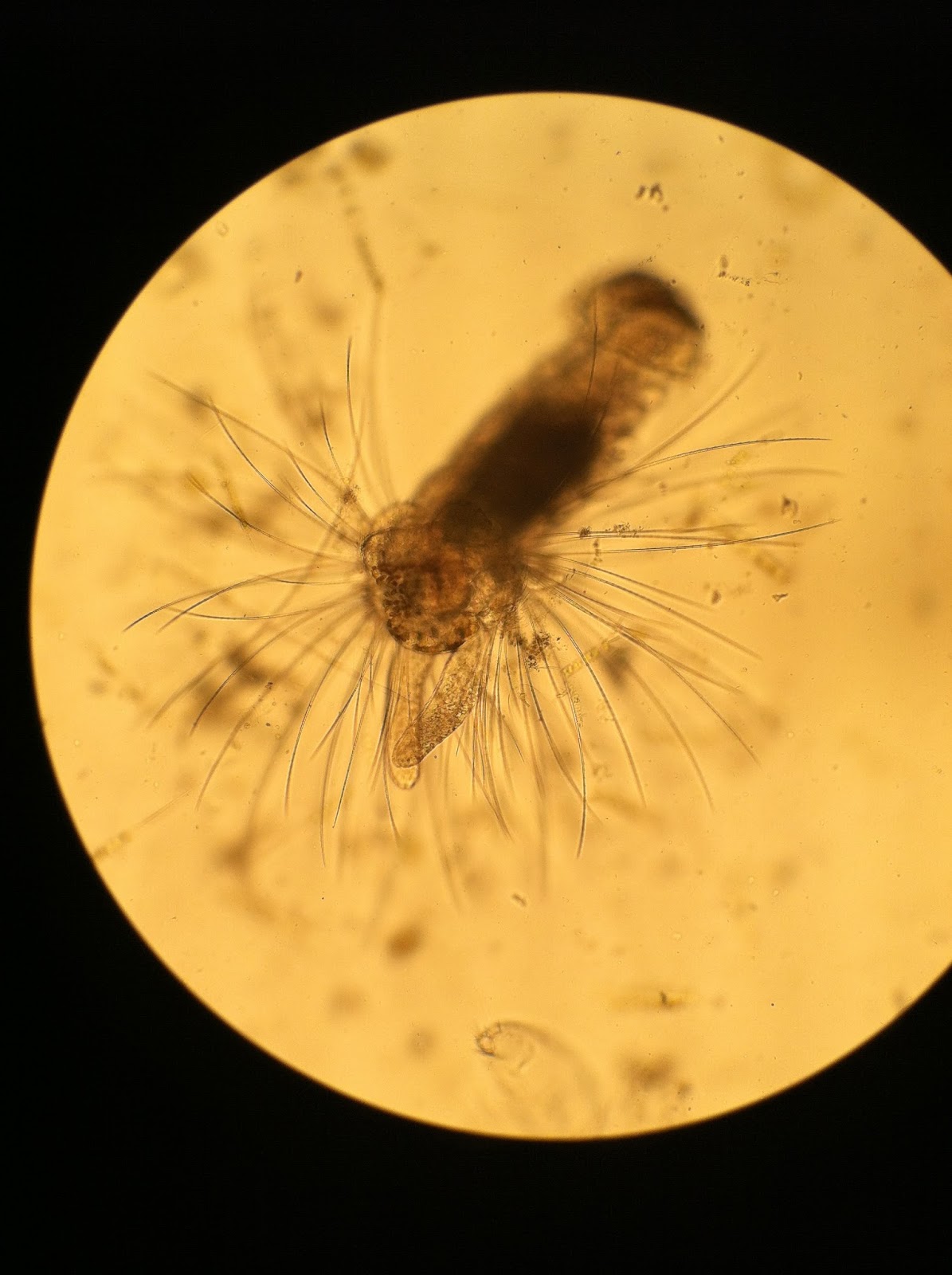
Polychaete

Barnacle Nauplius

Brachiolaria (second larval stage of sea star) amidst a lot of phytoplankton

Brachiolaria

Tintinnid


And, views of both zooplankton and phytoplankton from both dissecting scope and compound scope:


Cladocera, dissecting scope


Zoea, dissecting scope

Zoea, compound scope

Noctiluca scintillans

Noctiluca scintillans

Polychaete

Polychaete

Polychaete

Polychaete


And, some other interesting things:

Close-up of young jellyfish mouth

Close-up of young jellyfish tentacles
Ctenophore

A ctenophore's pharynx, stomach, and tentacle bases

A ctenophore's retracted tentacle

Finally, a few movies through the microscope:

Tracking a Dinoflagellate

The Undulations of a Polychaete

The Brachiolaria

The Living Sea, in the compound microscope

The Living Sea, in the dissecting microscope


Wednesday, July 9, 2014

Peter Sheesley - Week 2, The Rubber Hits the Road


Week two was a full week and several new activities were undertaken. Overall though, it was mostly spent looking at plankton under the microscope. I’m surprised how simply spending more time looking and attempting to classify organisms really does improve my familiarity with them, and my ability to differentiate between them. Now that I know just a little about the various phytoplankton and zooplankton, instead of seeing just a mess of squirming organisms, I instinctively categorize what I know and pay special attention to new or unknown shapes and movements. I suppose this is like the difference between two people watching a football game when one of them knows all the rules and offensive/defensive mechanisms, and the other person sees 22 people sporadically running into each other.

We went to Bastendorff Beach and Arago State Park to collect water samples using our well bailer tool. Bastendorff has an area with a wide surf zone and we took several samples there, on either side of a ridge. There is also a rock outcrop where we took some samples straight down from the rock, into a very narrow surf zone. We then headed south to Arago State Park and climbed down a steep cliff to a rock shelf in the surf zone. This was a bit more dangerous because a sleeper wave could cause one to lose footing and be swept out on the slippery rocks. Using much care, we got as far out as possible and threw the bailer into the surf. We kept samples, but probably didn’t get the sample from far enough out. The water samples were kept in approximately 250 mL plastic containers and preserved with lugols (iodine) drops.

Back at the lab we counted phytoplankton in the collected samples during the rest of the week. We are counting Chaetoceros (abundant diatoms consisting of spiny chains of discs), Pseudonitzschia (diatoms like spikes laid end to end), Dinoflagellates (a variety of shapes, with flagella and usually a reddish center), and Navicula (a unicell, pennate diatom). The Sedgewick-rafter slides hold one mL, so we count how many of each type are in a one mL concentrated sub-sample to get an estimate of how many would be in a one liter sample of the original. We only counted about ten samples, but so far our results seem to support the basic theory that more plankton are present in dissipative surf zones than in reflective surf zones.

We also spent a few mornings during week two tagging limpets for a separate research project of Dr. Shanks’. Specifically, we were tagging the limpet Lottia scabra, on the rocks in the tidal zone below Cape Arago. Tagging them involves sticking a small, lentil-sized piece of epoxy to the shell, and putting a small, numbered plastic tag in the epoxy. At first, the L. scabra limpets were somewhat difficult to find among the many Lottia digitalis limpets present. With a little practice though, finding them became easier. In general they are isolated, have sub-grooves between their main grooves, and have an apex that doesn’t tilt to the side. In addition to being tagged, each limpet is photographed. This will allow for future measurements of growth rate. It was interesting to see the algae-cleared circular area around some of the limpets that makes up their feeding zone. Apparently they move out into the zone to feed and then return to the same spot for years or even decades. This makes the spot they call home sometimes slightly depressed in the rock.

The third project of Dr. Shanks' we are occasionally participating in has to do with keeping a daily running count of crab larva and juveniles collected in a light trap off the nearby docks. For us this only involves retrieving the sample (emptying the trap into a bucket), if we happen to be out at the dock also collecting plankton. The light trap is a converted water bucket with holes in the sides, an extension chord running in to a light inside the bucket, and a filter at the bottom. At night the crab megalopae (second and final larval stage) are attracted to the light and enter the bucket. There are often polychaetes (worm-like creatures) and small fish in with the crabs. The samples are taken to the lab and counted by another student.

Overall, week two was exciting. We got out to the ocean to tag limpets and take water samples. And we started collecting data on our samples. Also, I continued to improve my plankton identification skills.


A clear indication of tilt in the rocks at Cape Arago. This affects the rocky surf zone nearby.


Me; casting the well bailer by hand into a reflective surf zone at Bastendorff Beach.


Some of the crab megalopae from the light trap.


A Lottia scabra limpet with a fresh tag. This one happens to be numbered "007" and named "Bond, Limpet Bond" :)


Me; demonstrating the process of attaching epoxy to a limpet.


Leyia, Dr. Shanks, and Pushkin arriving on the beach at Cape Arago to tag limpets.


Monday, July 7, 2014

Reporting to you here, live from the post (week 2) - By: Cindyjo Keomani Boungnavath

Hafa-adai!

This week's adventures were quite eventful as I attended Lab Safety Training, learned new modules for tailoring MS Excel to accommodate social science statistics, learned methods of how to take a good photo, as well as had my first call to local dispatch. 


The training was informational as it demonstrated the preventative measures to ensure safety when participating in a lab. The speaker discussed notable terms such as: Permissible Exposure Limit (PEL), Global Harmonization, Hazardous Waste, etc. where I learned the categorization of different materials. With the new modules for MS Excel, a couple of the men at the office (South Beach Annex) worked on formulas that would help with minimizing error with data input. We considered several designs and forms of both range-rules and a skip-fill methods that we later put into the program.

At my photo seminar/class, I walked away with many rules to take into consideration, for instance, try not to compose a photo (let it happen), allow the photo to tell a story (don't let it merely be a snapshot of a particular moment), and think about the lines and angles that exist within the frame (make it seem like an active still-shot), you want the photo to continue narrating even after you've glanced at it. 

And lastly, the call to dispatch was by far the most exciting thing about the project so far. With the surveying I do, I'm also held accountable to look out for any boats that float within the reserves. At Otter Rock, this past Tuesday (7/1/14), I spotted what looked like a private vessel with white rods or riggers sticking out of it and suspected some sort of activity since there seemed to be 3-4 men in what seemed to be wet suits toward the stern with possible lines going into the water. There also was a visible cab and an uncovered back deck where the men were standing. Protocol was if I suspected any "fishy" activity, to give ODFW a call, and so I did. I was told to give dispatch a call and report anything I saw. Within minutes, an Oregon State Police (OSP) truck pulled up next to my car and an Officer walked out to meet me. We went over the details of the boat and he jotted them down as well as my name and information. He was thinking they were headed towards a nearby port since they had already started on their way away from the reserves heading West. It was a lot to take in, especially once I realized what kind of power, and its extent, that I held given my responsibility and obligations working with a state agency. It was quite the eye-opener and settled me down into my seat to adjust myself to the severity of what my "job" entitles. 


Side Note:

On my way to Knight's Park for a day of field-work, I stumbled across an aggregate of elk beside someone's house close to the forest. I was at a lost of words seeing how many there were and their tranquil nature considering I snapped a few photos of the photo-op. 


All in all, a great work week! Looking forward to learning more about myself and from others...especially when least expected.

Bridget Begay - Week 2: Elk Sighting and Safety Training

Hello everyone,

In this past week, I've attended a lab safety training session, research seminar and a separate safety training for donning a immersion suit. But first, I would like to talk about assisting another fellow COSEE intern and new friend, Cindy! The project that Cindy is partaking in is the human dimensions project, where she analyzes the socio-economic effects of marine reserves for coastal communities. Her project is designed in such a way that she communicates a large amount with the public and deals with the data directly as she inputs it into a program that helps her team draw conclusions regarding the effectiveness of such policies and how it relates to research. When I went along with her on one of her field-days, we did a lot of observing and watched how people valued the reserve (as it pertains to their activity). The state parks that we visited were locate in Cascade Head: Knights Park, Roads Ends, Devil River, 35th and Nel Scott. While leaving the second to last location, Knights Park, we spotted deer resting underneath a tree near the road. We had to stop, observe them and take a few pictures. I have seen wild elk before on the Navajo Reservation in New Mexico, it's exciting to see them alive and well. I look forward to assisting Cindy in these upcoming weeks! 


Wild Elk spotted resting underneath a tree near Knight's Park. 

 Continuing with this weeks events, included a lab safety training session was very informative about how to be safe in and out of the lab environment. A few examples of the topics discussed was know your surroundings (labeled chemicals or samples, emergency items, other projects occurring in the same lab). A second topic discussed was referencing more than Safety Data Sheets (SDS) on handling any hazardous chemicals in lab, so consulting a lab assistant or scholarly literature. A few other topics was correctly labeling samples or items used in lab and knowing what kind of personal protective equipment (PPE) required in lab. I think this lab safety training confirmed information I knew and added more valuable information to be safe and alert in the lab environment. Next, the research seminar presented by Luisa Massarani was quite interesting. The main topic of the presentation was gaining insight on how effective a kid science exhibit is presented and constructed in the country of Brazil. I didn't know that Brazil's population survey indicate that they had about the same level of interest (in percentage) in sports as in science. I thought the kid's drawings of their experience of the science exhibit after a couple of weeks was cute and fascinating, especially to see how much they remember and how much it impacted them. Lastly, donning an immersion suit at the end of week was worth practicing because it's required that anyone aboard a ship has to be able to put on one in less than 60 seconds. We did an additional safety training because on July 11, I will be attending a cruise for sample data collection along the Oregon coast. I'm looking forward to this because it's exciting to be out on the water and to see what kind of soft-sediment fish live along the benthic zone or ocean floor. It's definitely going to be a learning experience to be aboard a research vessel again and applying safety procedures, including effectively communicating with the crew aboard. Thank you for reading and I will post pictures of the cruise in the near future. 


Bridget B.


When I took a walk to the South Beach State Park and managed to capture this beautiful sunset. 

View of the sunset from South Beach State Park. 


Sunday, July 6, 2014

Tabby Keefer's Second Week PRIME Experience

This last week has been a whirlwind of learning and new experiences. To name a few things; there was a lab safety meeting at a NOAA facility that all interns attended, I officially became part of Beaver Nation during the week, and I learned about visual or storytelling communications at the Oregon Department of Fish and Wildlife (ODFW).  On a side note, I attended a new student orientation at OSU last Tuesday, and felt so grateful to be associated with both Hatfield and the Corvallis campus (see image on right).

In addition, I bought a wetsuit for myself this week; which I will need in the following weeks. Why will I need a wetsuit? I will be going out this next week on the Oregon Coast Aquarium's boat, the Gracie Lynn, to collect data from marine reserves sites and a control sight. When put simply, two divers retrieve a buoy-like contraption which holds juvenile fish. Once it's on board, the crew captures the fish and terminates them for purposes of identification and data collection over at Oregon State University. This week, I will attempt to collect the buoy and get it back on board. Thus, the wetsuit.


Myself trying out snorkel gear for the first time

NOAA TRAINING
As boring as it might be, safety training is essential to every scientist and future scientists. I'll be quite honest, I've never taken a chemistry course in my life, and this new material was fascinating to me. I learned about the system of universal safety signs (Global Harmonization), and what to do with hazardous waste, among many other neat things. Keeping things brief, I am now prepared to step into a lab when the time is right! Let's move onto to something more exciting!

SOCIAL MEDIA "STORYTELLING COMMUNICATIONS"
To break things down I've been working with another intern, Hannah, in order to bring fresh eyes to the ODFW's Oregon Marine Reserves Flickr page https://www.flickr.com/groups/oregonmarinereserves/. We have been narrowing down the abundant amount of pictures on the web page, standardizing captions and making sure tags match the images while staying consistent. I have also been working with photo editing applications, to fix any lighting issues or make them more visually appealing. I have worked on an array of project this past week, but I have shifted a majority of my focus towards this Flickr project. I'm also in the process of writing a variety of protocols for the Oregon Marine Reserve's page (I will delve into this further next week).


MARINE RESERVES AND MARINE PROTECTED AREAS, WHAT ARE THEY?

Marine Reserves  are remarkably simple, they are areas where nothing can be taken (no take) or disturbed. That means no activities where wildlife is disturbed or extracted: no fishing, crabbing, etc. PERIOD! These areas include Cape Falcon, Cascade Head, Otter Rock, Caper Perpetua and Redfish Rocks. Cape Falcon's laws don't go into affect until 2016.

Marine Protected Areas  are typically near marine reserves. Restrictions in these areas aren't as tight as the marine reserves, but many activities are still limited. Each area has different rules and regulations, which ODFW has all the details for (see number below). For example, Redfish Rocks marine protected areas allows crabbing and salmon trolling, among recreational salmon fishing. As I have learned these past few weeks, it is nearly impossible to keep up with all the rules that go with marine protected areas.

I had quite an exciting week, and I cannot wait for the endeavors that week three has for me!


*If you see any violaters, please call the Oregon State Police dispatch number 1(800) 452-7888. If you want to know more information, call ODFW's Newport office at (541) 867-4741*

I found a gaggle of By-The-Wind Sailors this week while Cindy at ODFW was taking pictures at Nye Beach.

Tuesday, July 1, 2014

Leyia Johnson - Week One

Hello all,

My name is Leyia Johnson. I have recently graduated from Bellevue College with my second Associate Degree. This most recent degree is an Associate of Science (AS): Track II: Physics, Atmospheric Sciences and Engineering (Physical Sciences).

(For those of you that are curious, my first degree was also earned at Bellevue College in the spring of 2009 through the Running Start program. The Running Start program allows students in grades eleven and twelve to attend courses at Washington state colleges in lieu of high school. Therefore, I earned my high school diploma and my Associate in Arts & Sciences – Direct Transfer Agreement (AAS-DTA) simultaneously at the conclusion of my grade twelve year.)

This autumn, I will be attending the University of Washington Seattle as an Oceanography major. I intend to be a double major in Physical Oceanography and Biochemistry with a minor in Quantitative Science. I am thrilled to be a part of the program that sparked my interest in pursuing marine science.

This spark occurred several years ago in Washington DC while exploring in the Smithsonian. At the National Museum of Natural History, there is an exhibit on hydrothermal vents. Hydrothermal vents are springs of hot, mineral- and gas-rich seawater found on some oceanic ridges in zones of active seafloor spreading. I was fascinated by the communities of life found at the bottom of the ocean that relied not on photosynthesis, but chemosynthesis. Chemosynthesis is the synthesis of organic compounds from inorganic compounds using energy stored in inorganic substances. The exhibit sign referenced research done through the School of Oceanography at the University of Washington Seattle. The intrigue of this program lead to my decision to leave the Faculty of Arts at the University of British Columbia Vancouver and pursue an education in marine science, starting at Bellevue College.

At Bellevue College, I took Introduction to Oceanography with Marina Halverson. It was through her that I learned about Centers for Ocean Sciences Education Excellence – Pacific Partnerships (COSEE-Pacific Partnerships) “Promoting Research Investigations in the Marine Environment” (PRIME) funded by the National Science Foundation. I am excited for the opportunity to work in research. I love learning and now have the glorious opportunity to participate in the discovery.

It is only the first week and I have learned so much already!

My mentor is Dr. Alan Shanks at the Oregon Institute of Marine Biology (OIMB), University of Oregon. So far he has been wonderful in introducing us, (my fellow intern in the Shanks lab is Peter Sheesley), to the research environment and process. The first day Alan gave us several academic articles he authored to read. These articles lead us through years of his past research.

It was widely believed that the larvae of intertidal invertebrates (animals lacking backbones) were swept offshore during upwelling and back to shore during downwelling. Upwelling is a circulation pattern in which deep, cold water moves toward the surface and downwelling is a circulation pattern in which surface water moves vertically downward. A study Alan L. Shanks and R. Kipp Shearman conducted provided evidence against this hypothesis. They found that upwelling and downwelling had no effect on the cross-shelf distribution of the larvae of intertidal invertebrates. This lead to further research on what did have an effect on their distribution.

The Shanks lab has been linking the dispersal and recruitment of the larvae to nearshore physical oceanographic features.

One of my main interests in oceanography is understanding how systems function. It is interesting to learn how the geologic features effect the fluid dynamics and how the fluid dynamics effect the biological populations through larvae dispersal. I am so elated to be working on this project.

Thus far, I have learned how to cast a well bailer cast (a clear, plastic cylindrical tube) and retrieve a water sample from it. I have retrieved both a phytoplankton (tiny photosynthetic organisms that are suspended in the ocean) sample and a zooplankton (animal members of the plankton community) sample from a plankton net (a conical net made of fine mesh) and identified organisms in both samples. I am told that we will be counting Pseudo-nitzschia. Pseudo-nitzschia is a genus of diatom that produces a neurotoxin that causes humans to permanently lose short-term memory.

We have also emptied a light trap. The light trap is a large plastic bottle with holes in the sides and a light inside in order to attract crab. It mainly catches crab, but everything caught is documented. When we emptied the trap we found a fish! Alan informed us that it was a cabezon (a type of sculpin) and that they can grow to be enormous, (twenty-five pounds according to Wikipedia). The tiny cabezon we caught is our pet now. It lives in the lab in the sea table.

Unrelated to our project: Near our dorms we also found a newt, but we returned it to the creek nearby. I named it Newt Scamander for exploring the beasts to be found outside the creek.
Be sure to check back next week for another update on my activities here at OIMB!

Peter Sheesley - Pictures of worksite and equipment

Me, holding up the zooplankton collecting net.


The "F" dock, at the end of which we're collecting practice samples.


In the Shanks Lab, my double microscope set-up.


Sedgewick-rafter slides, filters, a sample, and a sample extracting tube.
A counter, for counting several types of plankton at once. And my lab notebook.


A sample viewing tray under the dissecting microscope.